GLOBAL HR PROFESSIONAL
Md. Hamid Raza Khan
Human Resources Manager
EPC & Oil & Gas | Construction | GCC / MENA | International Workforce
HR professional with 16+ years of experience in HR, mainly in the oil and gas, construction, and manufacturing industries. I have worked across Libya, Saudi Arabia, Qatar, and India.
About
Who I Am
HR professional with 16+ years of experience, mainly in the oil and gas, construction, and manufacturing industries across Libya, Saudi Arabia, Qatar, and India.
Most recently HR Manager with INTECH in Libya, supporting projects for Petrofac, Waha Oil Company, and Greenstream Gas in EPC, inspection and maintenance environments.
Core responsibilities include manpower planning and recruitment for blue-collar and white-collar positions, workforce deployment, employee relations, payroll, compensation, performance management, training, HR reporting, and policy development.
Previous experience includes bulk recruitment and workforce mobilisation at Jaddarah in Saudi Arabia (198+ client projects), HR operations at United Readymix in Qatar, and foundational HR experience at Just Dial in India.
MBA in Human Resource Management with hands-on experience in Oracle ERP, Odoo ERP, Zoho, Bullhorn ATS, and Microsoft Office.

Credibility
Professional Snapshot
Core HR Areas
Areas of Expertise
Strategic HR capabilities developed across international EPC, oil & gas, construction and manufacturing environments.
Core Competencies
Professional Skills
Journey
Company Environments
Professional experience across international oil & gas, construction, workforce services and technology sectors.
Global Reach
International Presence





Project Experience
Challenge → Action → Result
Results & Scale
Key Career Achievements
International HR Compliance
Labour Requirements by Market
Professional experience and context across four international markets. Presented as career experience, not legal advice.
Systems & Platforms
Technology & HR Systems
Analytics
HR Reporting & Workforce Metrics
Monthly HR reports covering manpower, recruitment, payroll, attendance, leave, turnover, training, performance and compliance.
Qualifications
Education, Languages & Additional Information
Languages
Additional Information
Professional Network
LinkedIn Hub
HR Insights & Professional Updates
HR Insights
Professional perspectives on project HR, workforce planning and mobilisation — drawn from 16+ years across Libya, Saudi Arabia, Qatar and India.
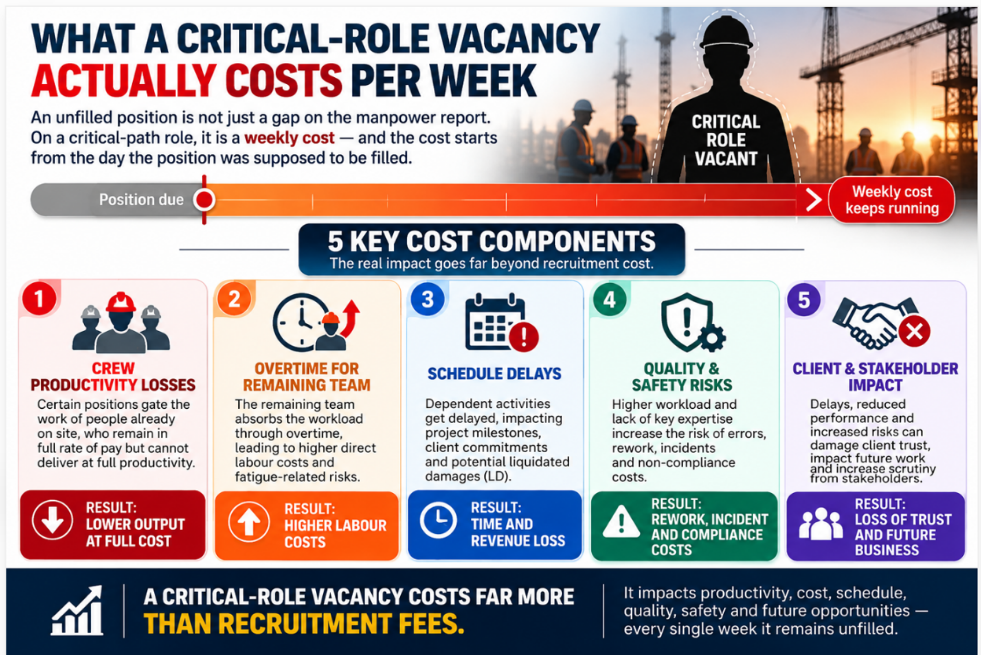
What a critical-role vacancy actually costs per week
Recruitment cost is just one part of the equation. The costs that often get hidden elsewhere are:
- Crew productivity around the empty role — Some positions gate the work of people already on site (still in full rate of pay).
- Overtime consumed by the remaining team — A direct operating cost, under operations and not HR.
- Schedule float consumed — Once gone, the next delay will impact the completion date, not the buffer.
- Client exposure — Particularly where the role is contractually named or linked to client approval.
- Rework and quality risk — When inspection, supervision or technical capacity is stretched.
Against all that, the cost of shortlisting additional candidates or paying above benchmark for a scarce discipline is relatively small and predictable.
Yet many organisations optimise the small predictable number and absorb the large uncertain one.
That is the cost of thinking of a critical vacancy as a recruitment problem and not an operating risk.
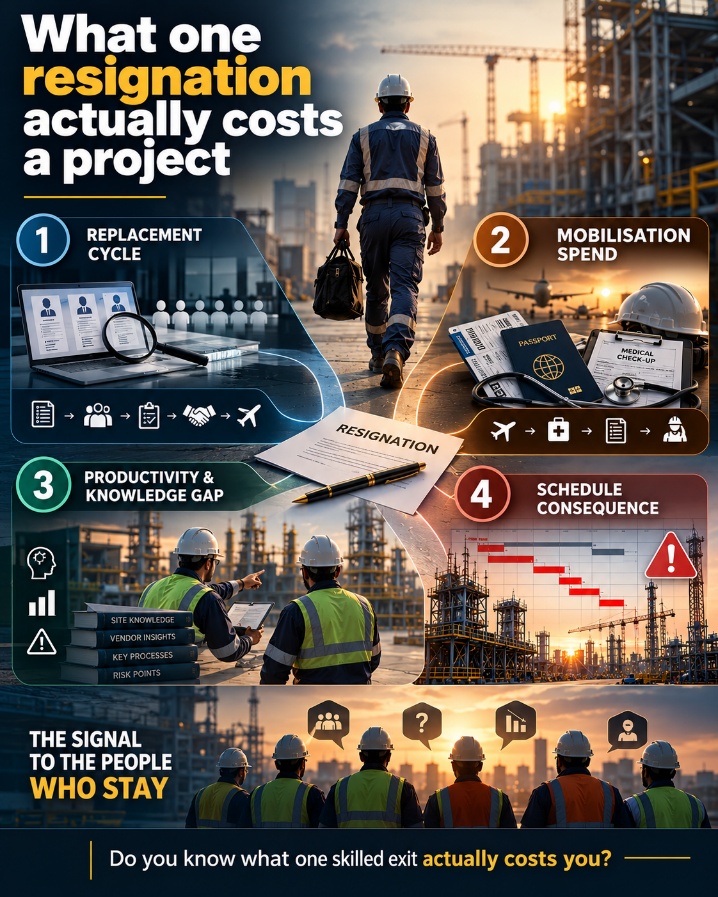
What one resignation actually costs a project
1. The replacement cycle
Sourcing, screening, trade test, offer, documentation, medical, visa, travel. For international roles, that can mean weeks of elapsed time while the position remains empty.
2. The mobilisation spend
Ticketing, medicals, attestation, induction. Money already spent to get one person to site does not automatically transfer to the next hire.
3. The schedule consequence
If that position sits on the critical path, the resignation is no longer just an HR issue. It becomes a delivery issue.
4. The signal to the people who stay
They watch who leaves. They watch what happens afterwards. And they form their own conclusions. The second resignation is often more expensive to prevent than the first one was to replace.
Many of the causes were addressable before any of this happened: micromanagement, feedback collected and filed, recognition programmes while the real problem is the supervisor.
Respect is not a benefit line. It may be one of the cheapest retention mechanisms on the list.
The hire who didn't board the plane ✈️
When we reached him, the reason was ordinary — a family matter he had not told us about. And there was another gap in the process: nobody had spoken to him directly for eleven days.
What changed after that? A direct call in the final week, from a named person, asking one question: "Has anything changed since we last spoke?"
Arrival confirmation became a two-way step. He confirms. We confirm. Both are recorded. One named coordinator stays with the candidate from offer to site, so the last conversation before departure is not with a stranger.
We also added a standing question at offer stage: "Is there anything in the next two months that could affect your travel?" Asked plainly, most people answer honestly.
None of this prevents every case. What it does is turn the cases we cannot prevent from an airport phone call into a week of notice — and a week of notice is a manageable problem.

Most manpower plans fail before recruitment even starts 🚧
Before a single requisition goes out, I want five things answered:
- What is the actual project scope, not the summary version?
- What needs to be on site on Day 1, and what can follow later?
- Which positions are on the critical path?
- How long do documents, medicals, visas and travel realistically take for this geography and nationality mix?
- What changes if the schedule moves by four weeks?
A plan that says "40 technicians in Q2" is a number. A usable manpower plan says who is needed, where, by which date, for which work package, and what the contingency is if one critical person drops out.
That is why I build backwards from the execution date — not forwards from the approval email. The objective is simple: the right people, in the right place, on the right day.

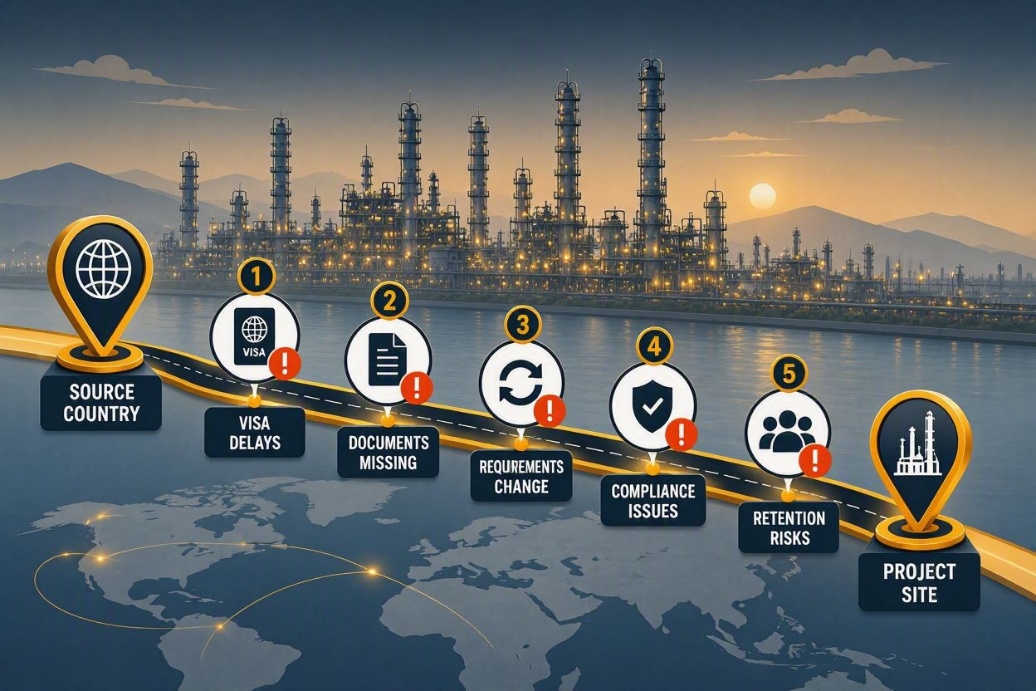
The five problems that never show up in the manpower plan
- Visa and immigration delays — One approval can move an entire shutdown schedule.
- Document gaps at source country — Medical fitness, attestations, NOCs. One missing document stops everything.
- Requirements that keep changing — Scope changes, client priorities change, mobilisation dates move. If the pipeline can't absorb that, you're sourcing from scratch while the project waits.
- Compliance across jurisdictions — Saudi Arabia has Qiwa, GOSI and Muqeem. Qatar has its own sequence. Libya brings another set. The details decide whether mobilisation moves.
- Retention in rotational workforces — You spend weeks finding and mobilising a skilled technician. He completes one rotation and doesn't return. Now it's another full mobilisation cycle.
These aren't theoretical. They come out of 198+ client projects and 100+ hires per month.
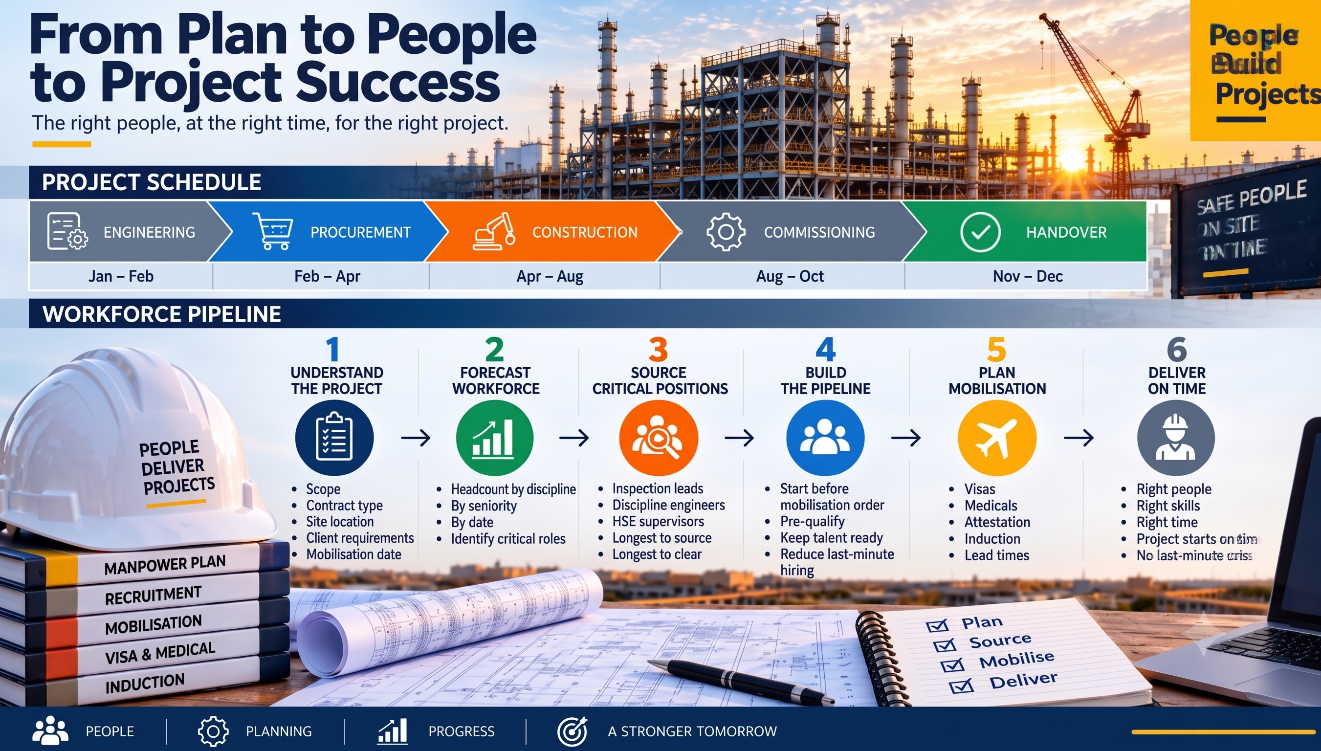
If you're waiting for the vacancy list, your manpower plan is already late ⚠️
📋 Understand the project before opening a requisition. A 30-day shutdown and a two-year rotational project look identical on a headcount sheet and need completely different plans.
📊 Forecast before recruiting. Headcount by discipline, seniority, date. Who has to be on site Day 1? Who can follow in week six? Which roles will be hard to find?
🎯 Critical positions go first. Inspection leads, discipline engineers, HSE supervisors. Longest to source, longest to clear. Bulk requirements run in parallel, not after.
🔎 Build the pipeline before the mobilisation order is signed. Waiting for the signature costs three weeks nobody gets back.
✈️ Treat mobilisation as part of the plan. Visas, medicals, attestation, induction. Every one has a lead time. Leave them out and the plan is fiction.
Good manpower planning is invisible. The project starts on time, the right people are there, and nobody calls HR at midnight asking where the manpower is.
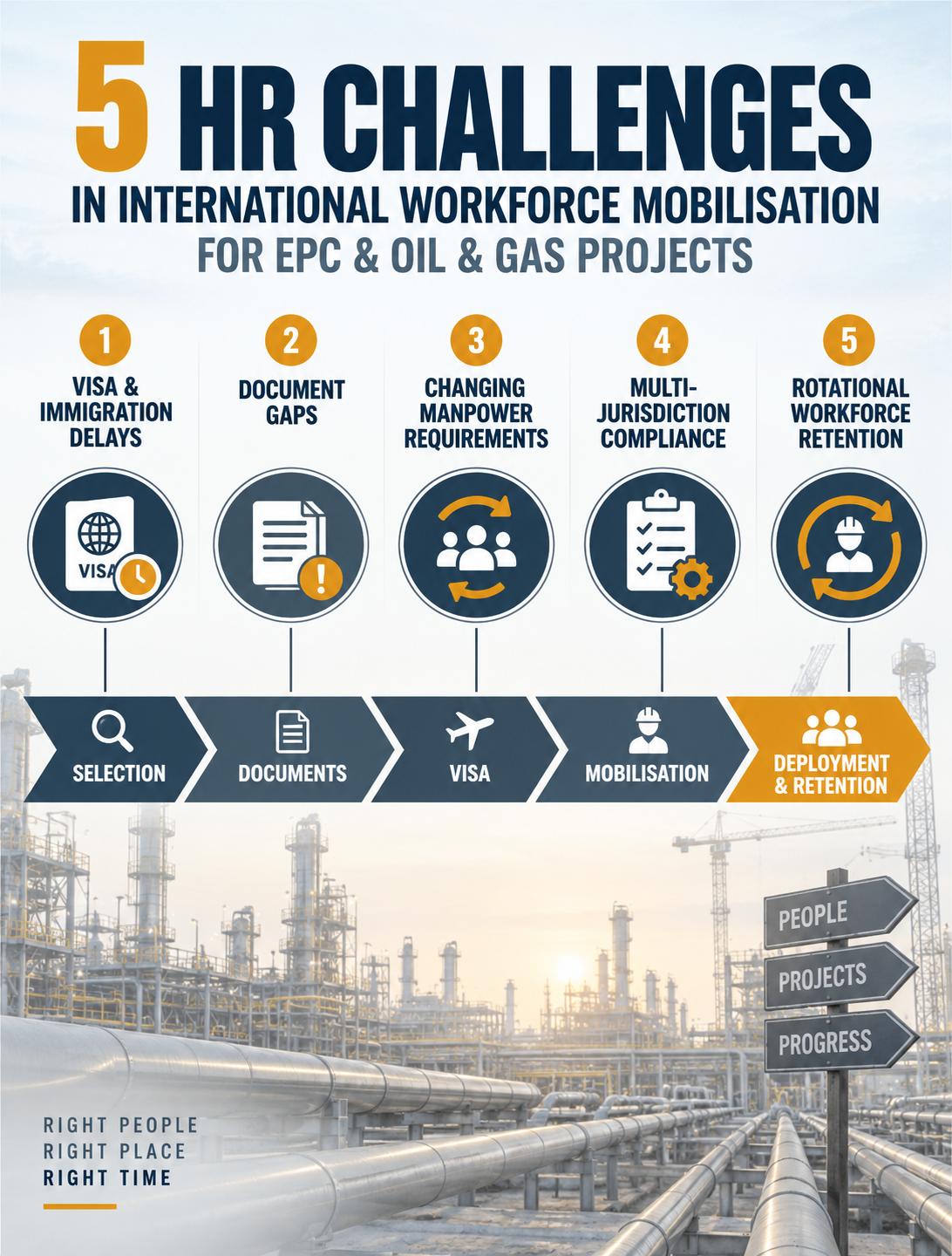
HR challenges I've seen when mobilising international workforces for EPC & Oil & Gas projects
1. Visa and immigration delays
The plan says a critical hire will be on site Monday. Then the visa takes another three weeks. When the role sits on a critical path or shutdown schedule, one delay can affect the wider project timeline.
2. Document gaps at source-country level
Medical fitness, attestations, NOCs and other documentation have to be ready before mobilisation. A candidate can be fully selected and ready to travel, but one missing document can stop the process completely.
3. Manpower requirements keep changing
Project scope changes. Client requirements change. Mobilisation dates move. The recruitment pipeline has to adapt quickly. Otherwise, HR ends up sourcing again while the project is already waiting.
4. Compliance across multiple jurisdictions
Saudi Arabia has Qiwa, GOSI and Muqeem. Qatar has its own processes. Libya brings another set of labour and site requirements. Managing these simultaneously requires more than a checklist. The details often determine whether mobilisation moves or stops.
5. Retention in rotational and shutdown workforces
You can spend weeks finding and mobilising a skilled technician, only for the person to complete one rotation and not return. Then the cycle starts again: replacement, documentation, mobilisation and additional schedule pressure.
These are recurring challenges in international project HR and workforce mobilisation.
Contact
Get In Touch
Send a Message
Analytics
Thank you for visiting

Live count from hits.sh · page views only, no personal data collected.